With the humanitarian aid sector facing unprecedented cuts and an existential crisis over its future, the need for independent reliable data and analysis on humanitarian finance and funding trends is more important than ever.
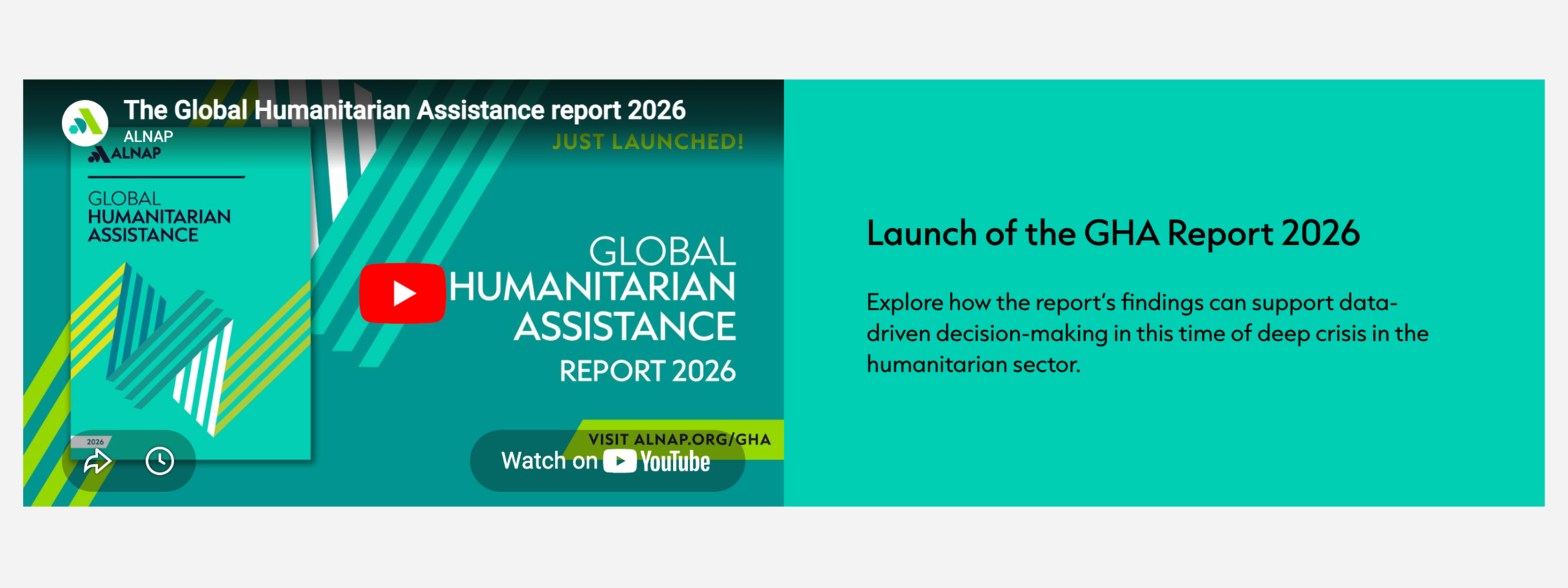
ALNAP launch event sessions of the Global Humanitarian Assistance (GHA) 2026 Report
Published on 29 June 2026
GLOBAL HUMANITARIAN ASSISTANCE
Strengthening the humanitarian system by providing independent financial analysis
For those who were unable to attend either of the launch event sessions of the Global Humanitarian Assistance (GHA) 2026 Report on findings and implications, you can catch up on the event recording and explore the report below.
Prefer a short read? Read or download the Summary:
- Summary (EN) - https://alnap.org/help-library/resources/global-humanitarian-assistance-gha-report-2026/summary/
- Summary (AR) - https://alnap.org/help-library/resources/the-global-humanitarian-assistance-report-2026-summary/arabic/
- Summary (FR) - https://alnap.org/help-library/resources/the-global-humanitarian-assistance-report-2026-summary/french/
- Summary (ES) - https://alnap.org/help-library/resources/the-global-humanitarian-assistance-report-2026-summary/spanish/
Read or download the full report: https://alnap.org/help-library/global-humanitarian-assistance/
Watch a recording: In English with Arabic or French subtitles (toggle the captions to get the preferred language).
Access the GHA Report 2026 presentation at your leisure:
-
Presentation (EN) – https://alnap.org/documents/21608/EN_Presentation_slides_ALNAP_GHA_Report_2026_launch.pptx
-
Presentation (AR) -https://alnap.org/documents/21607/AR_Presentation_slides_ALNAP_GHA_Report_2026_launch.pptx
-
Presentation (FR) -https://alnap.org/documents/21609/FR_Presentation_slides_ALNAP_GHA_Report_2026_launch.pptx
The evidence and perspectives shared are thought to help inform policy, planning and performance in your organisation or institution.
Event overview
The evidence in this year’s report has not been comfortable reading. The humanitarian system is facing its own crisis – from record funding cuts to152 million excluded from vital assistance. Meanwhile, great hopes for the Grand Bargain have severely faded.
In the humanitarian sector, it often takes a very extreme crisis to trigger real reform. During the event, contributors discussed how this ‘humanitarian recession’ is playing out in reality. Does this finance crisis pose an unexpected pivot moment for the system? Our contributors painted a picture of both risk and opportunity.
Patrick Katelo, Executive Director of PACIDA in Kenya described the devastating impact that cuts have had on local organisations like his in East Africa, while Mahmoud Hamada of Palestinian NGOs Network explains that the increase in international funding for the humanitarian response in Palestine has led to international organisations undermining the work of local and national responders.
Sameera Nori, Executive Director of COAR in Afghanistan reflected on the vulnerability of a humanitarian system that is overdependent on a limited number of major government donors. She pointed out that local actors and communities in crisis are first to feel the impacts when donor priorities change.
Irwin Loy, senior policy editor for The New Humanitarian discussed the relationship between the emerging clarity of government donor motivations alongside a somewhat less clear narrative around the sector's own position.
Freddie Carver, Director of HPG at ODI Global, felt that the ‘changing of the guard’ in the donor landscape could result in more equal conversations and partnerships.
Anita Kattakhuzy, Director of Policy for NEAR Network, raised issues around OCHA’s role moving from response coordinator to managing a very large pool of government funds and in the process becoming a gatekeeper.
ALNAP welcomes your feedback:
How do you rate the importance and quality of the Global Humanitarian Assistance report? In order for ALNAP to continue to produce reports like the GHA2026, it is vital to understand its impact and learn how it can be made into an even more useful tool.
Please take the short, simple survey to help answer these questions. Complete here: https://www.surveymonkey.com/r/RR9MDC3