
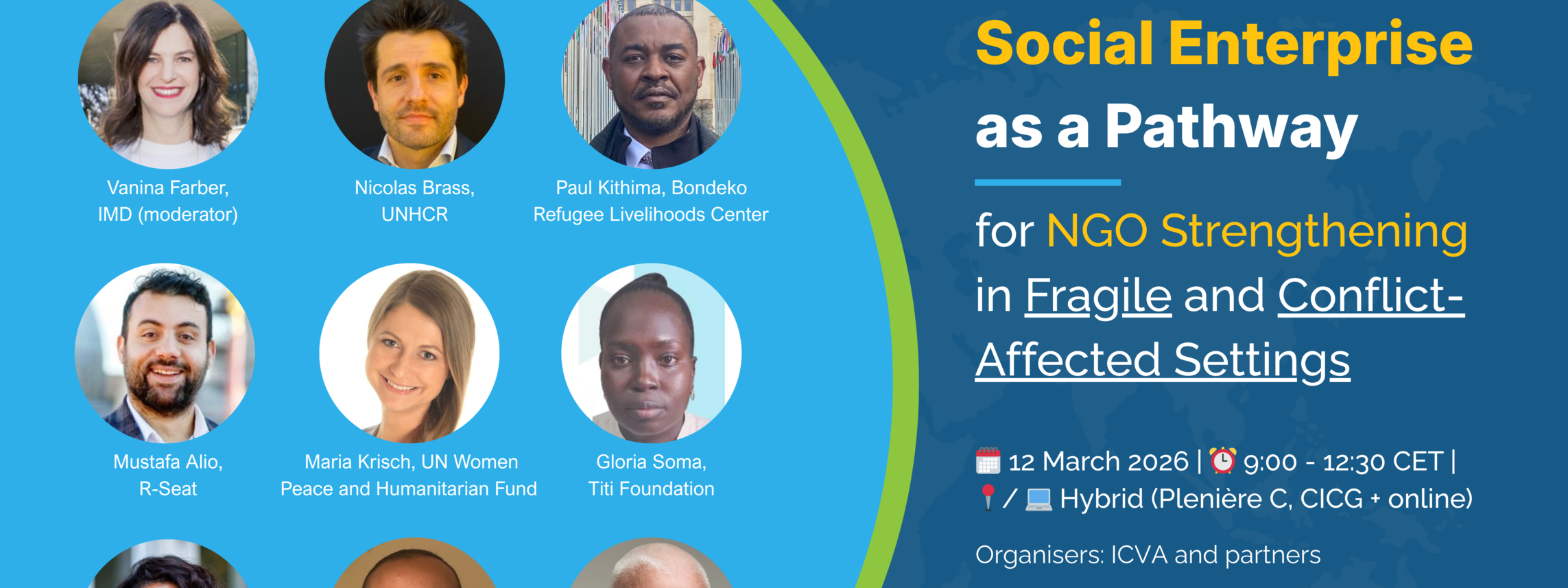
Social Enterprise as a Pathway for NGO Strengthening in Fragile and Conflict-Affected Settings
Too many critical non-governmental organisations (NGOs) working in fragile and conflict-affected settings have been directly impacted by reductions in traditional humanitarian funding. Often operating in resource-poor environments and faced with strong competition and increasing demands for accountability and sustainability, NGOs struggle to diversify their financing sources away from INGO or UN partnerships – even though traditional grant-based models are no longer sufficient to ensure institutional resilience or the continuity of critical services for crisis-affected communities.
There is a growing number of local civil society actors who are exploring social enterprise models – income-generating business approaches grounded in social impact – to diversify revenue streams, strengthen organisational autonomy, and build more sustainable service delivery. Social enterprises have demonstrated potential to support economic inclusion, foster innovation, expand local partnerships, and reinforce community-led development.
However, these models are fraught with substantial barriers to entry, including limited access to capital, restrictive regulatory frameworks, operational insecurity, and gaps in business development skills. There is also limited evidence on how social enterprise models can be adapted for high-risk contexts while reinforcing, rather than diverting, humanitarian mandates.
This panel showcased refugee-led and women-led organisation experiences in building and maintaining social enterprises and collectively examined with experts the barriers to entry and pathways to success in fragile and conflict-affected countries.